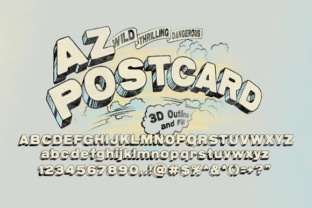
AZ Postcard 3D: A Practical Look at a Versatile Digital Asset Set
Digital creators and marketers constantly search for assets that offer both visual impact and workflow efficiency. AZ Postcard 3D has emerged as a notable option in this space, providing a collection of three-dimensional postcard templates that aim to bridge the gap between nostalgic print media and modern digital presentation. Rather than simply rendering a flat image with depth, this set focuses on creating dimensional postcard objects that can be placed, rotated, and lit within a scene. For anyone producing content that calls for a tactile, travel-inspired, or correspondence-themed visual, understanding what AZ Postcard 3D actually delivers is worthwhile before committing time or budget.
What AZ Postcard 3D Offers in Practice
At its core, AZ Postcard 3D provides a series of postcard models that are fully three-dimensional. This means the postcard itself has thickness, subtle curvature, and realistic edge wear in many variants. The set typically includes multiple postcard designs, ranging from blank templates to pre-designed fronts featuring iconic Southwestern imagery, vintage typography, and landscape scenes. The back sides often include realistic stamp placements, cancellation marks, and handwritten-style text zones. Because the assets are fully dimensional, they respond naturally to lighting changes, camera angles, and environmental reflections. This makes them suitable for product mockups, social media visuals, video intros, and even print-adjacent digital presentations where a flat PNG would feel lifeless.
One of the most practical strengths of AZ Postcard 3D is the way it handles texture detail. The paper grain, the slight yellowing along edges, and the subtle gloss differences between the front image and the writing area on the back all contribute to a convincing analog feel. For creators who need to evoke nostalgia, travel, or personal communication, these details matter significantly. A generic 3D plane with a photo slapped on it does not carry the same emotional weight. AZ Postcard 3D deliberately includes these imperfections, which actually enhance believability in renderings.
Core Strengths and Design Considerations
When evaluating AZ Postcard 3D, several characteristics stand out as especially relevant for professional use:
- Modularity: The postcards are typically organized as separate 3D objects rather than a single scene. This allows users to drop individual cards into existing projects without restructuring their workflow. You can pull one card for a hero image, another for a background element, and a third for a video transition element.
- Texture resolution: The assets generally include high-resolution maps that hold up well under close scrutiny. Even when the camera moves in for a macro-style shot, the paper texture and ink details remain crisp.
- Lighting readiness: Because the geometry includes actual depth, the shadows and highlights behave correctly without requiring extensive post-processing. A standard three-point or HDRI setup produces natural results with minimal adjustment.
- Variety without overload: The set usually offers a focused selection of designs rather than hundreds of nearly identical options. Each card tends to have a distinct visual identity, which reduces decision fatigue while still providing enough choice for most projects.
The design language leans toward a vintage or retro aesthetic, though some cards use cleaner layouts that work in contemporary compositions. This range means the set is not locked into a single era or style. A brand promoting a heritage product could use the aged cards, while a modern travel agency might prefer the cleaner blank templates and add their own branding.
Evaluating Quality and Real-World Performance
In real-world use, AZ Postcard 3D performs reliably across common rendering scenarios. The geometry is clean enough to avoid shading artifacts, and the texture mapping is consistent. Users working with Blender, Cinema 4D, or similar software should find the import process straightforward, provided they check for material assignment compatibility. Some versions of the set include pre-configured materials that assume a specific render engine, so reviewing the documentation or file names before importing saves time.
A key consideration is how the assets handle scaling. Postcards in physical reality have a standard size range, and the 3D models reflect that. If you scale them drastically outside their intended proportions, the thickness and edge details may appear unnatural. For most uses, keeping them near their original scale works best. This is not a limitation so much as a reminder that the assets are designed to mimic real objects, not abstract shapes.
The texture work deserves specific mention. The handwritten-style elements on the back of some cards use simulated ink that has slight variability in stroke weight and opacity. This avoids the sterile look of a digital font and instead reads as genuinely manual. For marketers creating materials that emphasize authenticity, craftsmanship, or personal touch, this detail can elevate an otherwise straightforward mockup.
Who Stands to Benefit Most from AZ Postcard 3D
AZ Postcard 3D is not a universal tool for every creative project. Its value becomes clearest in specific contexts:
Social media and content creators who need quick, attractive visuals for posts about travel, nostalgia, letter-writing, vintage aesthetics, or personal storytelling will find the set immediately useful. A single postcard rendered against a simple background can become an entire post, and swapping out the design or angle produces fresh content without starting from scratch.
Bloggers and publishers covering travel, culture, or design topics can use the postcards as featured images, section headers, or email newsletter graphics. The dimensional look adds texture to layouts that might otherwise rely entirely on flat photography or icons.
Small business owners in tourism, hospitality, or creative services can incorporate the postcards into promotional materials, website hero sections, or physical product mockups. A bed-and-breakfast, for example, could render a postcard featuring a local landmark and use it across social media, email signatures, and print-on-demand merchandise.
Freelance designers and agencies handling branding or campaign work for clients in the travel or lifestyle sectors can use AZ Postcard 3D as a starting point for mockups. The dimensional quality helps sell a concept more effectively than a flat composite because it communicates how the final product might feel in hand.
Educators and course creators teaching design, 3D modeling, or visual communication can use the postcards as example assets or project components. Students can practice lighting, composition, and material adjustment on assets that already have professional texture detail, focusing their learning on scene building rather than asset creation.
Practical Applications and Workflow Integration
Integrating AZ Postcard 3D into a typical workflow takes minimal effort. Because the assets are individual objects rather than complete scenes, you can import one or several cards into a new project and arrange them as needed. For a product mockup, a single postcard placed on a desk or wall surface with subtle shadowing creates a convincing presentation. For a video intro, a stack of postcards that fan out or flip over animates well and provides visual interest without complex rigging.
One practical recommendation is to use the blank templates as a base for custom branding. If a client needs a series of travel-themed social posts, you can load a blank card, apply their imagery and copy as a texture override, and maintain the dimensional realism of the original asset. This approach saves modeling time while preserving the tactile quality that flat alternatives lack.
The set also works well in combination with other vintage or paper-themed 3D assets. If you have envelopes, stamps, or handwritten letters from other collections, AZ Postcard 3D matches the aesthetic without clashing. Consistency across assets is important for professional results, and this set maintains a coherent visual language that pairs naturally with similarly styled items.
For those working in e-commerce, the postcards can serve as lifestyle imagery for printed products. A store selling postcard-themed merchandise can render the actual product design on the 3D model, showing customers exactly how the card will look with its physical depth and finish. This reduces returns and increases buyer confidence, as the image more closely matches the physical item.
Considerations and Limitations
No asset set is perfect for every situation, and AZ Postcard 3D has aspects worth noting before purchase. The aesthetic leans distinctly vintage and travel-oriented. If your project requires ultra-modern, minimalist, or corporate postcard designs, you may find the default styles less suitable. While blank templates offer flexibility, you would still be working with a paper texture that implies age rather than pristine newness.
Texture resolution, while good for general use, may not satisfy extremely high-end print work where the camera zooms to extreme close-ups of the paper fibers. For web, social media, standard video, and most marketing materials, the resolution is more than adequate. Only those producing billboard-sized renders or cinematic macro shots need to test the limits.
Software compatibility can occasionally present minor hurdles. Some versions of the set assume a specific render engine or material node setup. Checking the product description or asking the creator about supported formats before purchasing saves frustration. Most providers offer common formats like OBJ, FBX, or native .blend files, but verifying this is a small step that prevents workflow interruptions.
Finally, the set is a collection of assets, not a tutorial or template for creating your own 3D postcards from scratch. If your goal is to learn how to model and texture paper objects, this set provides excellent reference but not instructional content. For immediate use in projects, however, it delivers ready-made quality without requiring modeling skills.
Final Thoughts on Fit and Value
AZ Postcard 3D fills a specific niche well. It offers dimensional postcard assets with thoughtful texture detail, a focused but varied design range, and practical modularity that fits into existing workflows. For professionals and creators who regularly produce content with a travel, nostalgic, or personal communication angle, the set saves significant time compared to building such assets from scratch. The quality holds up under typical rendering conditions, and the flexibility of blank templates extends the set's usefulness beyond its pre-designed options.
If your work rarely calls for postcard imagery, or if you need only flat graphics that can be created with Photoshop, the investment may not justify itself. But for those who value realism, efficiency, and a consistent vintage aesthetic across multiple projects, AZ Postcard 3D delivers on its premise without overpromising. It is a practical tool for specific jobs, and knowing when those jobs arise is the key to getting full value from the set.